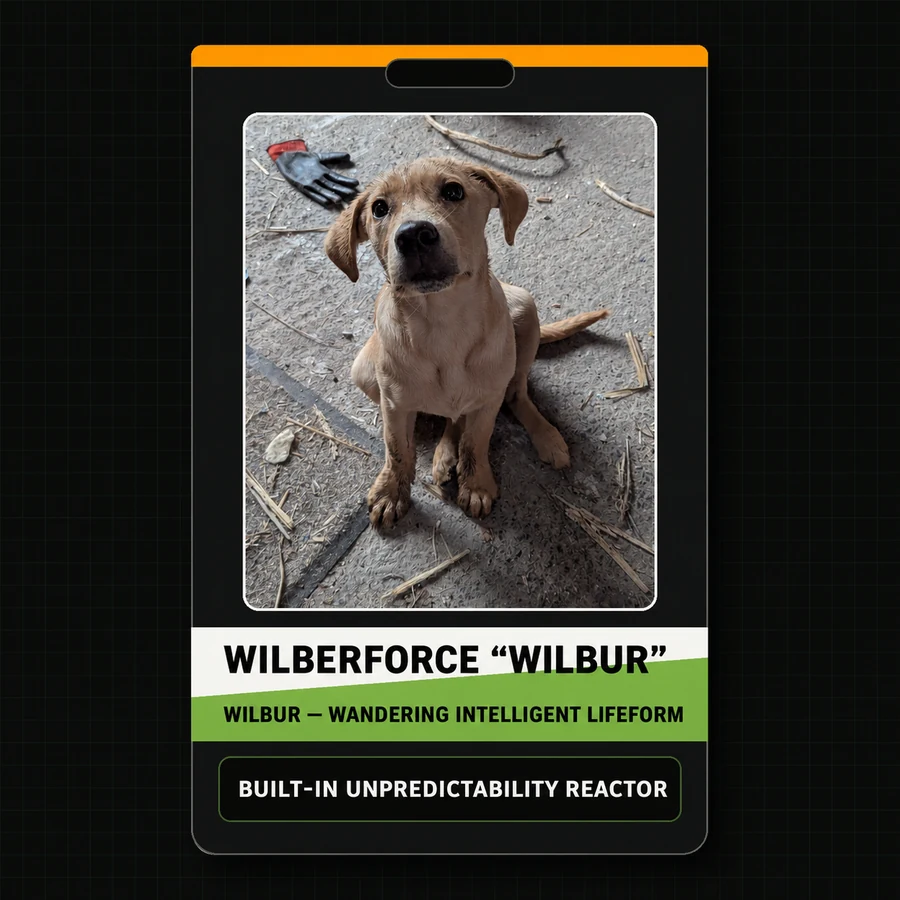
WILBUR — WANDERING INTELLIGENT LIFEFORM; BUILT-IN UNPREDICTABILITY REACTOR
The shed’s mobile, autonomous ‘assistant’ attends most experiments, inspects everything at nose height and occasionally rediscovers items nobody else knew were missing. Results are returned in exchange for snacks, unless he has already decided the result is the snack.
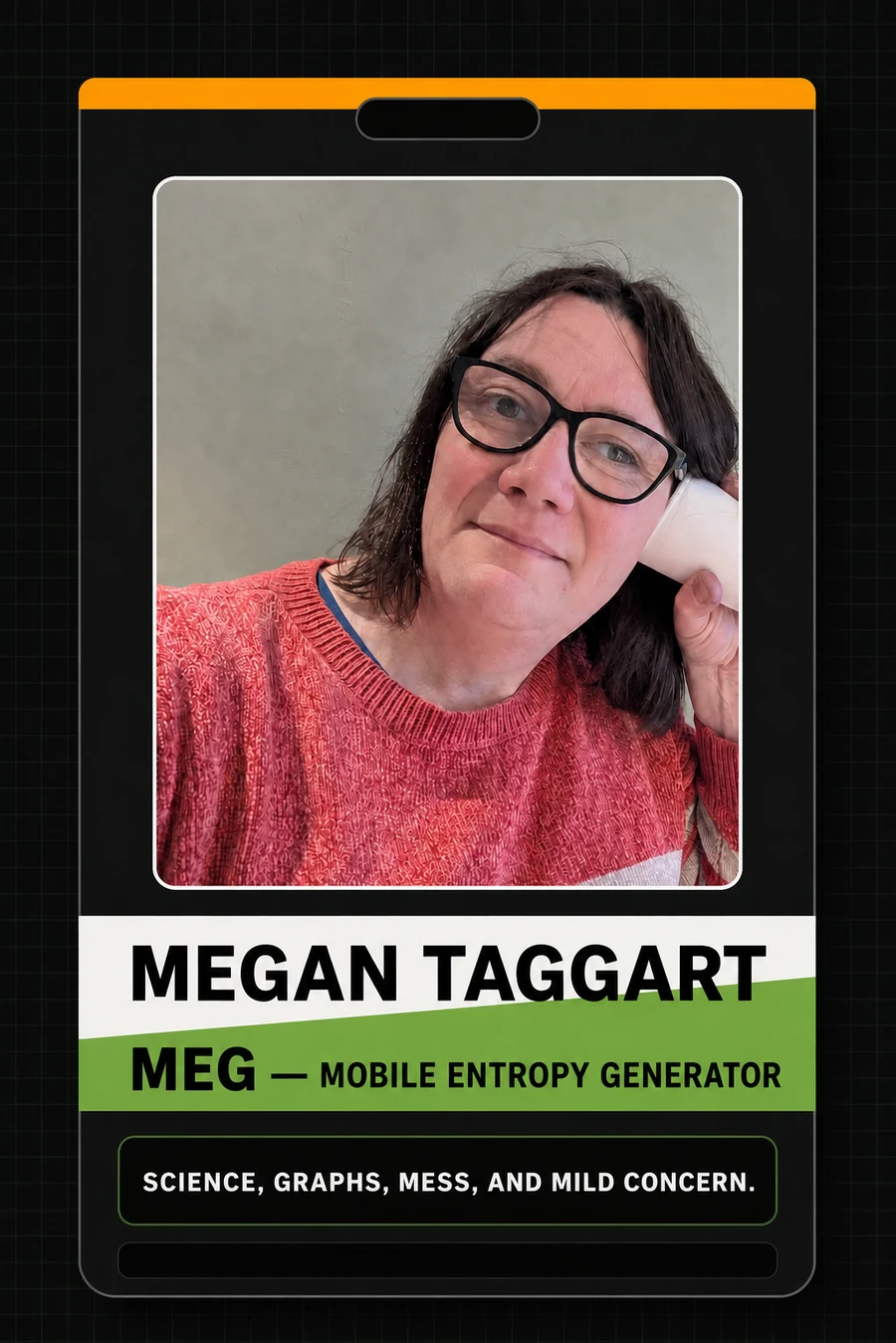
MEG — MOBILE ENTROPY GENERATOR
I’m from Northern Ireland: home of some oddly shaped rocks and a famously large ship that sank. Most of my projects begin with an unnecessary question and end with someone asking why there is a large satellite dish tracking the Moon.
Research, construction, escalation. I work as a researcher, and outside work I make things to find out how they work, what they can detect, and whether I can make them a little better. That usually involves some combination of physics, maths, electronics, software, radio, instruments, graphs, and a regrettably optimistic amount of aluminium.
I do not so much have hobbies as temporarily acquire entire fields. I get interested in something, read everything I can find, acquire the necessary equipment, and turn it into a full-blown project. Then another interesting idea condenses out of the vacuum and the previous one enters a period of extended contemplation. This is why everything is generally in a state of high entropy.
How does this usually start?
Normally with a passing thought, a rough scribble, or a question that seems as though it should have a quick answer. Shortly afterwards, there are parts on order, several new sub-projects, and a growing suspicion that the original question has led into treacherous terrain densely populated by rabbit holes.
Does any of it get finished?
Yes, quite a lot of it. I can usually make the thing work. The difficulty is persuading my attention to remain on the same thing long enough for everyone else to consider it finished. Other projects aren’t abandoned; I just haven’t persuaded my attention to return to them yet.
The working method is: Scribble. Escalate. Build. Tweak. Success optional.
I rarely know where a project will lead when I begin it. An innocent question about accurate time may end with an atomic frequency standard on the bench; an interest in radio astronomy may produce a suspiciously Arecibo-shaped hole in the garden. By then, the original question is usually the least complicated part.